EventStorming workshop
Getting the whole organisation – and the software that runs it – moving in the same direction
Getting the whole organisation – and the software that runs it – moving in the same direction
For CTOs, product and business-area leads who are starting a new initiative and need business and tech aligned and pointing in the same direction for it to succeed.
You have a vision but can’t seem to get people to pull in the same direction.
Your legacy system is out of sync with the business and in desperate need of an update.
It’s like business and tech are speaking completely different languages.
Your software team can describe the system in detail, but not the business processes it's meant to support.
Each team is optimising for itself, not the whole business.
You have an idea about what needs to change, but don’t know if it holds for the whole company.
You've tried getting everyone on the same page before, and it didn't stick.
Realising you need to get aligned is the easy part; creating a clear enough picture to actually agree on is much harder.
The people who already see where things need to go tend to talk mostly to each other, instead of to the people who are not on board yet. Since the software teams are usually left out of those conversations, they keep building based on inherited assumptions rather than on how the business actually works. In most companies, no one is sharing new ideas with everyone who needs to weigh in, from both the business and software side.
Before starting the journey, you need a shared, multi-dimensional picture of where you are and what the real problems are. And for it to work this has to be created collaboratively by the people who will need to act on it, including those building the software that must keep working as the business changes.
That's the foundation your change initiative needs: a common language, clearly surfaced disagreements, and the whole group – business and software alike – working toward the same goal instead of each team guessing what the other one needs or optimising for itself.
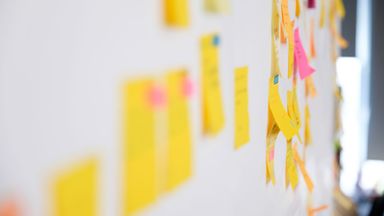
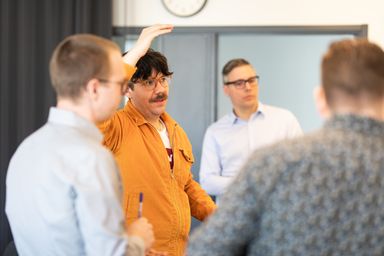
That's where EventStorming fits in. It's a workshop format created by Alberto Brandolini, where people from all parts of the company get together to describe business processes using sticky notes. It is closely related to Domain-Driven Design, but is a useful tool by itself.
All models are wrong, but some are useful.
– George E. P. Box
A good EventStorming model surfaces uncertainties and disagreements early, before they turn into expensive misunderstandings later.
A wall or paper roll full of sticky notes describing what you mapped out
A lot of aha-moments and new insights
Clearly visible areas of uncertainty or disagreement
A trash-can full of sticky notes that were replaced, rewritten, obsoleted, or merged with others as we gained more understanding together
A shared, deep understanding of what was modelled
Several needed follow-up conversations with people who were not in the room
Depending on where you are and what you need.
The starting point if you are new to EventStorming. 10 to 15 key people from both business and tech, over one to three 3-hour sessions. Creates a high-level view of the whole business flow, plus the first sketches of a shared language.
A smaller group (4 to 8 people) focuses deeply on a single flow: commands, actors, read models, policies, external systems. Usually one to two 3-hour sessions. Creates a model of one process.
Bridges the model to software: system boundaries, aggregates, UX sketches. Usually 4 to 8 people over one to two 3-hour sessions. Used when the need arises, not usually planned upfront with the other two.
We're a key part of the DDD community and have practiced it since the start, with deep software architecture experience across both greenfield and brownfield work.
Facilitating EventStorming well means balancing facilitation and participation; you know the specific business processes, we bring the format as well as business and software experience from a wide range of projects that allow us to ask the questions that reveal deeper insights.
There are two things people tend to agree on after an EventStorming session: it was very productive, and it was mentally demanding. Or, as one participant put it:
Damn, I've learned so much today.